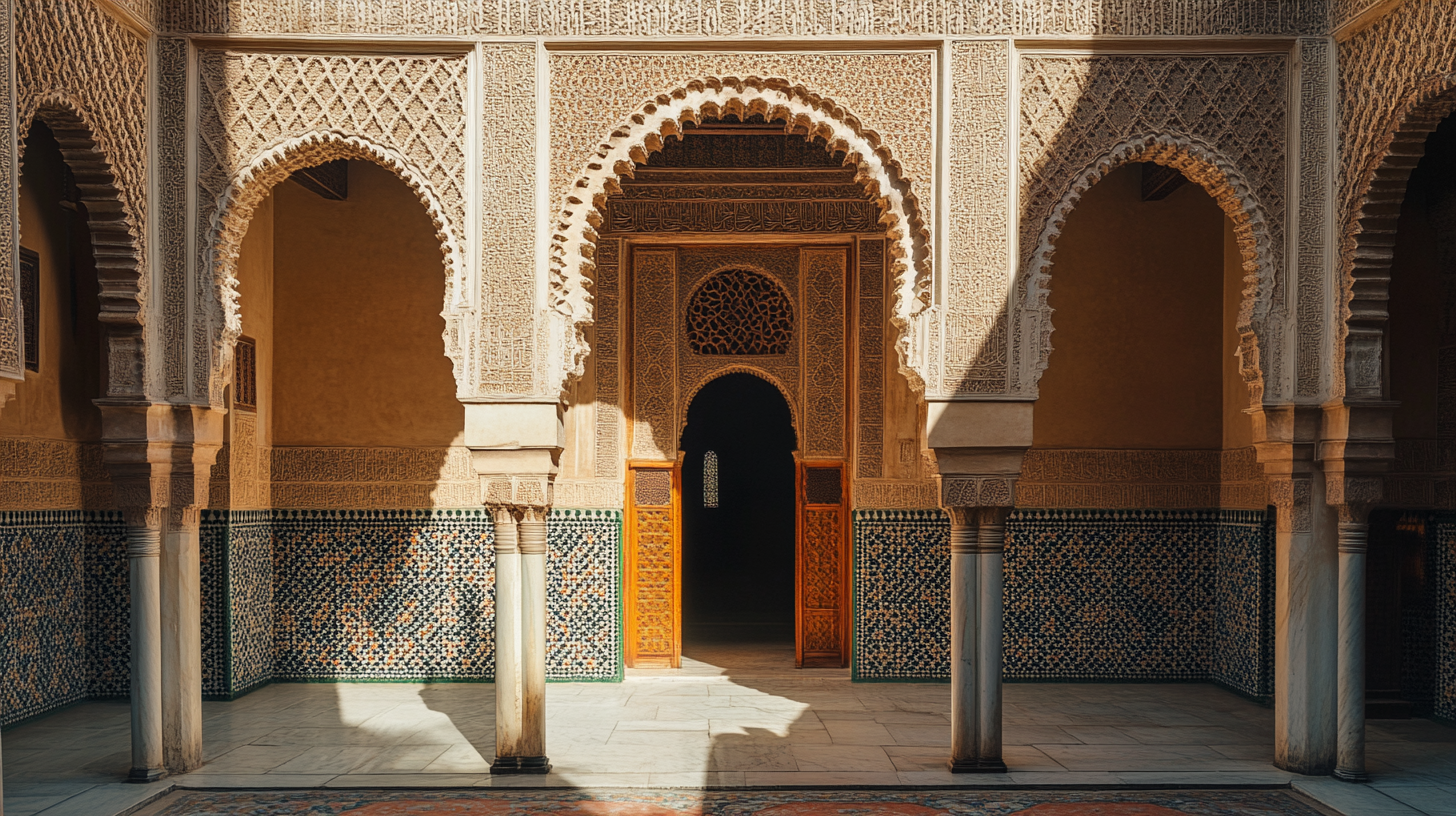
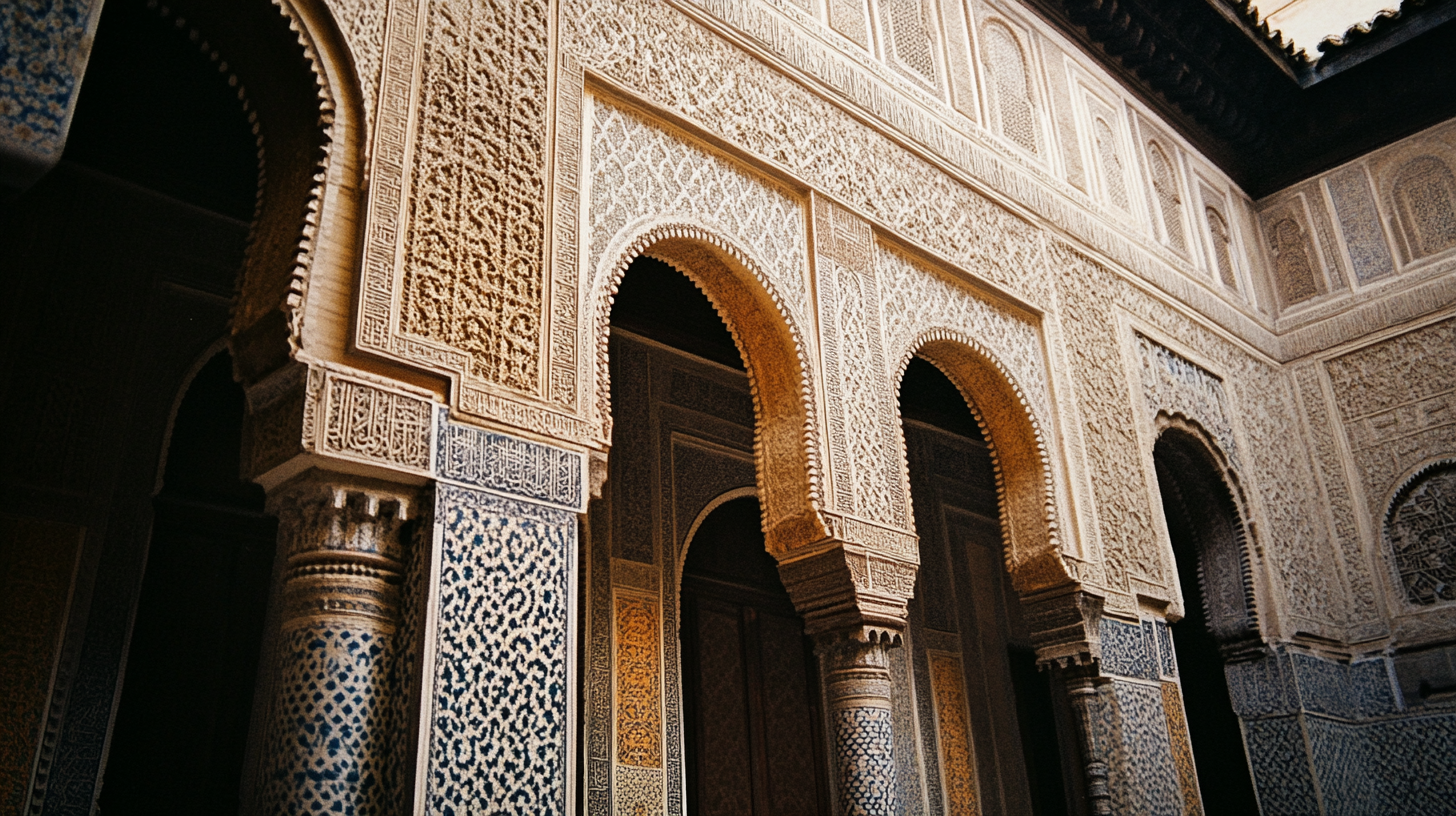
Every Islamic building in Morocco speaks three visual languages simultaneously. Zellige tilework covers the lower walls in geometric precision. Carved stucco rises above it in flowing arabesques. Painted cedar ceilings crown the space with calligraphy. Together, they create a total environment — not decoration applied to architecture, but architecture as decoration.

This is not accidental. The avoidance of figurative imagery in Islamic sacred art — rooted in the prohibition of idolatry — produced one of history's most extraordinary creative constraints. Denied the human figure, Moroccan artists poured eight centuries of invention into abstraction, achieving a mathematical and aesthetic sophistication that Western art would not approach until the 20th century.

The Three Disciplines

01

Geometry

Zellige & Carved Stucco

Islamic geometric art begins with the circle and a compass. From the circle, regular divisions produce grids of triangles, squares, hexagons, and stars — the raw material of pattern. In Morocco, this mathematics takes physical form in zellige: hand-cut ceramic mosaic assembled piece by piece into interlocking designs of breathtaking complexity.

The craft uses 360 named shapes in Darija. A master (maalem) works on his knees, cutting each tessera with a sharp hammer against a chisel — the same technique used since the 10th century. In 2019, Harvard's metaLAB discovered that some zellige patterns contain quasi-crystalline structures, the same aperiodic mathematics that earned Dan Shechtman the Nobel Prize in Chemistry in 2011. Moroccan craftsmen had been laying quasi-crystals for eight centuries before Western science described them.

The second geometric medium is carved stucco (gebs). Wet plaster is incised with geometric, floral, and calligraphic patterns before it sets — a race against time that demands absolute precision. The Saadian Tombs in Marrakech represent the art's high point, with layers of carved stucco creating shadow-play as light shifts through the day.

02

Arabesque

The Infinite Garden

If geometry represents order, the arabesque represents growth. Flowing lines of branches, leaves, and tendrils intertwine in patterns that have no beginning and no end — a visual metaphor for the infinite nature of creation. The Arabic term is tawriq (leafwork) or islimi.

Moroccan arabesques are distinctive: denser, more tightly wound, and more intensely coloured than their Ottoman or Persian equivalents. The characteristic Moroccan palmette — a stylised half-leaf that splits and recurves — appears on surfaces from the Almoravid Qubba in Marrakech (c. 1120) to the carved stucco of modern riads. It has scarcely changed in 900 years.

In Morocco, the arabesque occupies a specific architectural zone: the middle register. Zellige tiles cover surfaces from floor to roughly 1.5 meters; arabesques in carved stucco fill the walls above; and painted wood (typically cedar) covers the ceiling. This three-part hierarchy — mineral, vegetal, celestial — mirrors the traditional Islamic cosmology of earth, garden, and heaven.

03

Calligraphy

The Word Made Visible

In Islamic tradition, calligraphy is the highest art — the visible form of the spoken word, and the spoken word is the vehicle of revelation. Morocco developed its own calligraphic tradition, the Maghrebi script, distinguished by its rounded letterforms and extended descenders. It remains in use today.

Three scripts dominate Moroccan architecture. Kufic — angular and geometric — appears on the oldest monuments and is often integrated into geometric patterns so seamlessly that letter and ornament become indistinguishable. Maghrebi cursive carries Quranic verses across the walls of medersas and mosques. Thuluth — grand and ceremonial — marks entrances and foundation inscriptions.

The bands of calligraphy that wrap Moroccan interiors are not merely decorative. They are readable texts — Quranic verses, hadith, poetry, and dedications to the ruler who commissioned the building. The Bou Inania Medersa in Fes carries its entire foundation inscription in carved stucco around the courtyard, recording that Sultan Abu Inan built it in 1351–1356 "for the glory of God and the benefit of students."

The Hierarchy of Surfaces

Upper register Painted cedar Calligraphy, stellar geometry Heaven
Middle register Carved stucco (gebs) Arabesque, floral, calligraphy Garden
Lower register Zellige tilework Geometric pattern Earth
Floor Marble, zellige, tadelakt Simple geometry Foundation

Technical Diagrams

Zellige 8-point star geometric construction from circle division
Fig. 1 — Khatam (8-point star) derived from compass-and-straightedge division of the circle into 8 equal parts.
Three-register decorative wall hierarchy: zellige, carved stucco, painted cedar
Fig. 2 — Interior wall section showing the three-register hierarchy: zellige (earth), carved stucco (garden), painted cedar (heaven).

Where to See It

Bou Inania Medersa, Fes

1351–1356

The only medersa in Morocco with its own minaret. All three decorative disciplines deployed at their highest level. The courtyard is a textbook of Marinid art.

Al-Attarine Medersa, Fes

1325

Smaller and more intimate than Bou Inania. The carved stucco arabesques are among the finest surviving examples in the Islamic world.

Ben Youssef Medersa, Marrakech

1565

The largest medersa in Morocco. Saadian dynasty restoration produced a riot of zellige, stucco, and cedar that overwhelms with its density and precision.

Saadian Tombs, Marrakech

1578

Lost for centuries, rediscovered in 1917. The Hall of the Twelve Columns represents the zenith of Saadian decorative art — muqarnas ceilings, Italian Carrara marble columns, and stucco so fine it resembles lace.

Hassan II Mosque, Casablanca

1993

Proof that the tradition lives. 6,000 Moroccan artisans worked 80 million hours over six years. Every surface is hand-finished in traditional techniques — the largest deployment of traditional Islamic art in the modern era.